· IT DEV · 7 min read
Google Business Profile now connects with GA4 and is managed through Gemini
Google is integrating Google Business Profile with Analytics 4 and Gemini. What this means for businesses, what you can do in practice, and where the limitations are.
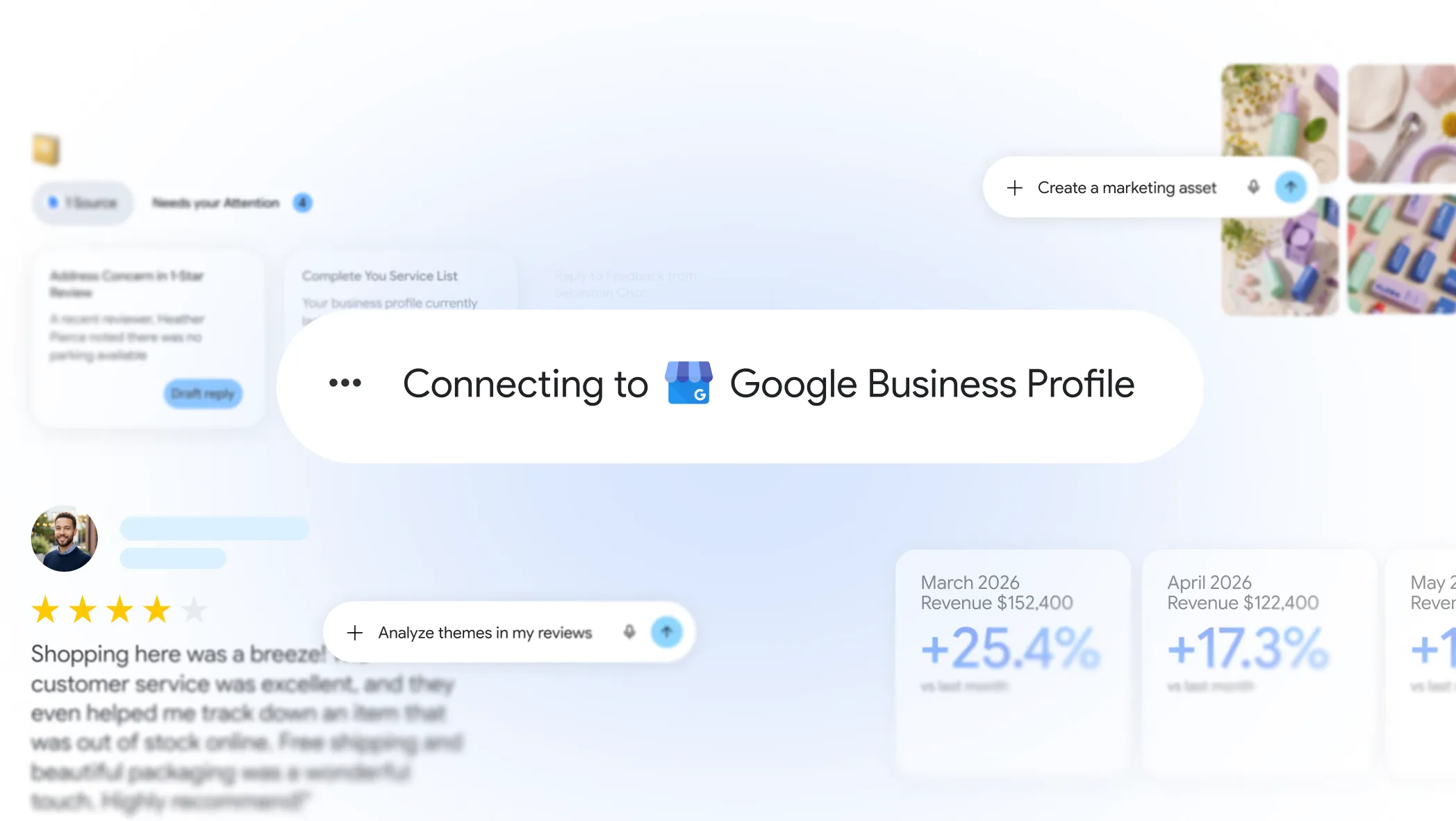
Google no longer sees Google Business Profile as a standalone platform you “just need to fill out.” It is adding two integrations that change the way a business can manage and measure its profile.
On one side, Gemini becomes an assistant that talks to your profile. On the other, profile data flows into Google Analytics 4, right alongside your website traffic.
For anyone involved in local SEO, this is not a minor update. It is two steps toward a more unified picture: what customers see on Maps, what they do next, and how you can manage it all without opening five different tools.
What Google Announced
In summary, we are looking at two separate but complementary developments:
- Google Business Profile integration with Gemini, so you can manage your profile using natural language.
- Google Business Profile integration with GA4, so local data appears in your Analytics reports.
Both target the same problem: many small businesses have claimed their profile but do not update it, do not respond to reviews, and do not know whether it is actually “working.” Google wants to reduce that friction.
Gemini as an Assistant for Google Business Profile
Within Gemini you will be able to connect your Google Business Profile and use it like a conversation, not like a control panel with dozens of menus.
What You Can Do in Practice
Instead of searching for where each setting is, you can ask directly:
“How did my business do this month?” Gemini can analyze views, direction requests, calls, and overall profile engagement.
“Help me respond to the latest review.” It suggests a draft reply based on the specific comment, so you do not have to write from scratch every time.
“Change the hours for the holidays” or “Create a post about the new offer.” Profile updates and posts without manually navigating to each section.
The idea is simple: Gemini draws on real context from your business, not generic answers you could find in a blog post.
Business notebooks: organization and reminders
Alongside this, Google introduced Business notebooks. These are an extension of the notebooks already available in Gemini, specialized for businesses.
In simple terms, they give you a space where:
- you see what needs immediate action (e.g. responding to a customer question, holiday hours that have not been set),
- you get suggestions for offers, pricing, or positioning based on your local environment,
- you move quickly from idea to action (e.g. campaign concept and results analysis).
Important note: Business notebooks will not be available in the UK and the EEA. The Gemini integration with Google Business Profile will roll out, but the notebooks may need to be tracked separately if Google changes its policy.
Why This Matters for Small Businesses
Many owners do not “ignore” their Google Business Profile. They simply do not have time. One moment you are the manager, an hour later you are customer service, and then you need to respond to a review, upload a photo, and check the stats.
Google knows this. That is why it is trying to reduce the burden: fewer platforms, more automation, a more natural workflow.
For those of us who work in Local SEO, this means that clients who already take care of their profile will have an even greater advantage. Those who leave it incomplete will look even further behind compared to competitors who respond quickly, update regularly, and leverage the new tools.
How to Connect Gemini
The rollout began in June 2026, worldwide. It will connect one Google Business Profile at a time.
Google promises activation with one tap. Once official instructions with screenshots are available, we will add them here as well. For now, keep this in mind: if you manage multiple profiles (e.g. as an agency), you will need a separate setup for each business.
Google Business Profile Data in GA4
The second big piece of news is about data. Until now, profile monitoring was done primarily through the Insights section of Google Business Profile. Useful, but separate from what you see in Analytics for your site.
Now you can connect your profile to GA4 and see local data on the same platform as the rest of your digital marketing.
What Data Appears
After linking, a dedicated Google Business Profile section will appear in the GA4 Reports menu. There you will see, among other things:
- profile interactions,
- phone calls,
- bookings,
- direction requests,
- clicks to the website,
- messages,
- menu views.
The data covers the last 6 months from the moment of linking.
Why This Helps a Local Business
Imagine being able to answer questions like:
- How many people saw my profile and then visited my site?
- Which actions (call, message, directions) bring the most value?
- What is happening on Maps compared to organic traffic?
With GA4 and GBP in the same place, you stop jumping between two dashboards. You see a more complete picture of your local presence.
For businesses already investing in SEO, Google Ads, or content, this is gold. You can connect map visibility with website behavior and, ultimately, with conversions.
What It Does Not Do (Yet)
It is good to be realistic. The integration has limitations:
- Aggregated data: you can link multiple profiles, but you cannot easily break them down by location in the report.
- Less flexibility in custom filters and reports compared to standard GA4 events.
- 6 months of history, not a full archive going back forever.
In other words, it does not fully replace Google Business Profile Insights. It complements them and brings them closer to the rest of your analytics stack.
How to Connect Google Business Profile with GA4
You need:
- an Editor or Admin role on the GA4 property,
- an Owner or Manager role on Google Business Profile.
The process starts from the GA4 Admin panel:
- Open Admin and go to Product links.
- Select Google Business Profile.
- Click Link and follow the steps.
- Confirm the connection.
Once complete, check the Reports menu for the new GBP section. If it does not appear immediately, give it a few hours. It often takes time to sync.
What the Two Updates Mean Together
If you look at them together, the picture is clear:
| Aspect | Gemini + GBP | GA4 + GBP |
|---|---|---|
| Goal | Management and action | Measurement and analysis |
| What you gain | Faster responses, updates, ideas | Unified view of local + web data |
| For whom | Business owner without time | Marketing manager / agency |
Google is building an ecosystem where Google Business Profile is not “the listing on Maps” but a local presence hub that feeds AI, analytics, and (likely in the future) even more automations.
For businesses, the message is simple: your Maps profile is not optional. It is the first point of contact for thousands of searches every day. And now, Google is giving you tools to run it more easily and measure it more accurately.
What You Can Do Today
You do not need to wait for all features to take action:
- Check if your profile is complete. Categories, photos, services, hours, website link.
- Connect GA4 if you have Admin/Editor access and check the new reports section.
- Try Gemini as soon as the integration becomes available in your region.
- Build a review routine. Even without AI, responding quickly builds trust.
If you want help with strategy, see our article on turning Google Business Profile into a customer acquisition engine or the Local SEO packages we offer.
Conclusion
Google is finally merging two worlds that until recently existed separately: managing the local profile (through Gemini) and measuring it (through GA4).
For small businesses, this reduces friction. For those who take local marketing seriously, it opens up a better view of performance.
The question is no longer “do I need a Google Business Profile?” The question is: will you leverage it before your competitors do?
If you want us to review your profile, GA4 reports, and what can be improved, get in touch.