· IT DEV · 9 min read
Agentic Browsing Google now scores your site for AI agents
In May 2026 Google added an Agentic Browsing category to Lighthouse and PageSpeed Insights. See what it measures, why there is no score out of 100, and how to pass all three checks, including llms.txt.
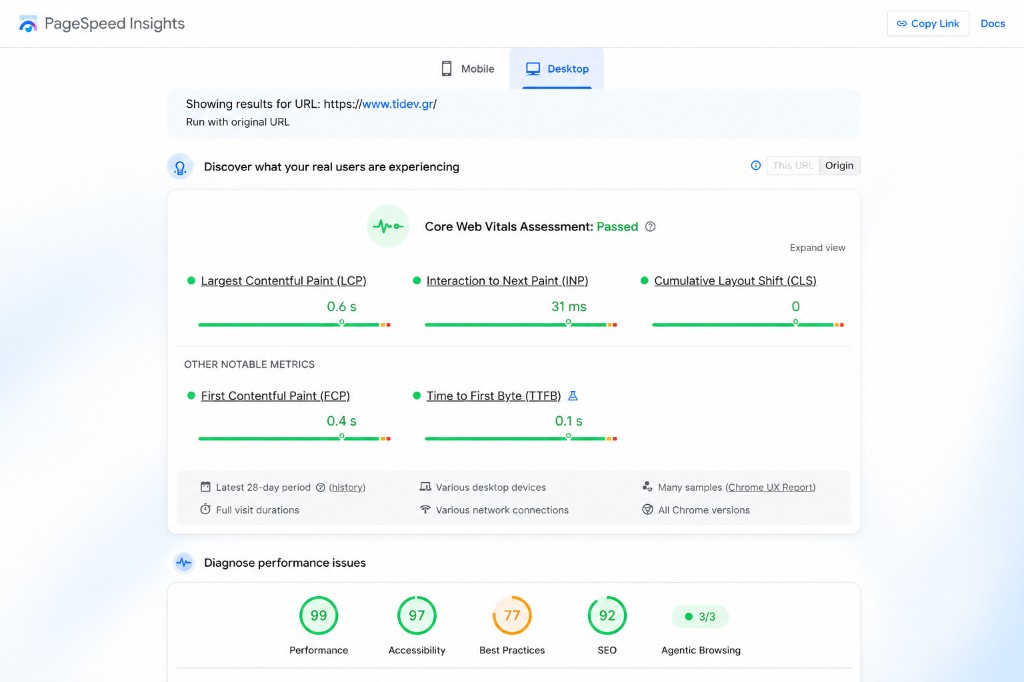
In May 2026 Google quietly added a new category to Lighthouse and PageSpeed Insights: Agentic Browsing. It does not give a score out of 100. It shows a ratio, e.g. 3/3.
It measures how ready your site is for an AI agent to read it, understand it, and act on it without a human at the controls. And one of the three checks concerns llms.txt, a file that Google has started to evaluate officially.
What Is Agentic Browsing and Why Google Added It
Run a page through PageSpeed Insights today and you will see something that did not exist a few months ago. Next to Performance, Accessibility, Best Practices, and SEO a fifth result appears: Agentic Browsing.
Google introduced it without much fanfare. Lighthouse 13.3, released on May 7, 2026, placed the new category in the default config, and PageSpeed Insights inherited it within two weeks. By the time most people noticed, it was already running on every report.
The category measures something no other category touches: how ready your page is for AI agents — the assistants that visit websites on behalf of users to compare, summarize, and book appointments.
This is a significant shift in what Google measures. Performance is about the human waiting for a slow page. Accessibility is about the human using assistive technology. Agentic Browsing is about software: assistants and agents that now visit sites.
The Three Checks It Actually Runs
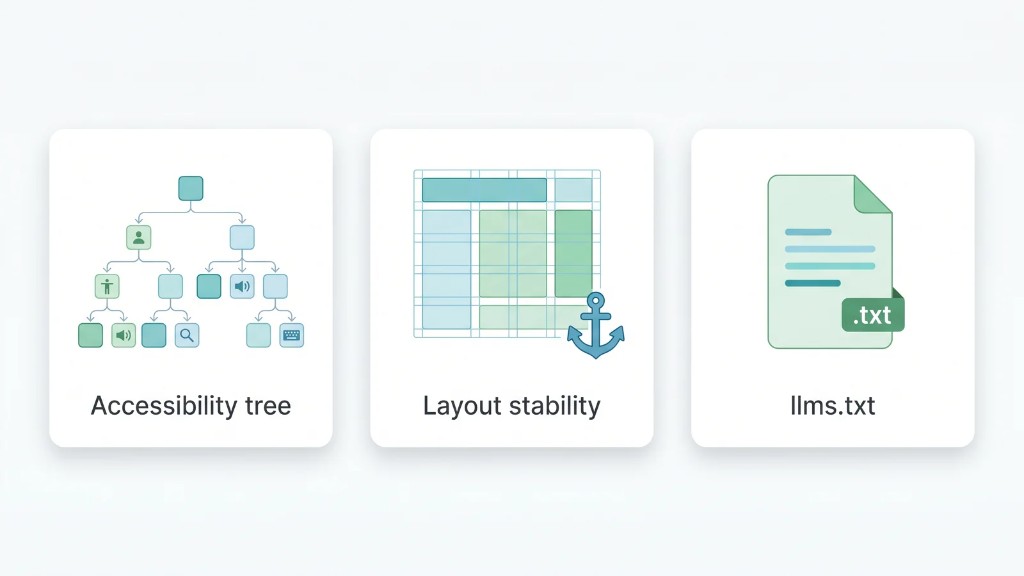
There is already plenty of confusion around this category, with articles inventing audits that do not exist. The accurate picture, according to the official Lighthouse documentation, is as follows. In PageSpeed Insights, the default Agentic Browsing result is built from three checks.
1. Accessibility tree
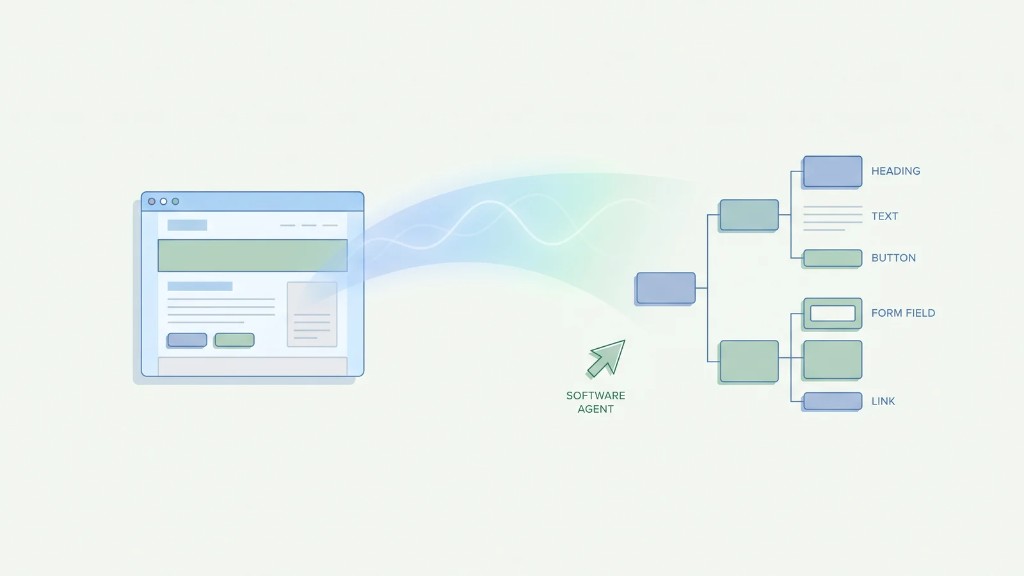
It reuses the accessibility work Lighthouse already does, but filters it down to what a machine needs. Do the interactive elements have proper names? Are the roles and parent-child relationships valid? Is anything interactive hidden from the tree?
An agent does not see your beautiful buttons. It reads the accessibility tree — the same simplified structure a screen reader uses — because it is the cleanest map of what the page contains and what can be clicked.
2. Cumulative Layout Shift (CLS)
You already know CLS as a Core Web Vital, the metric that penalizes pages where content “jumps” during loading. Here it is reframed for agents.
Many agents take a screenshot of a page and reason on top of it. If the layout keeps shifting, the screenshot the agent is using may no longer match the page underneath. A button moves, the agent clicks on empty space. Stability is no longer just about “polish.” It is about correctness.
3. llms.txt
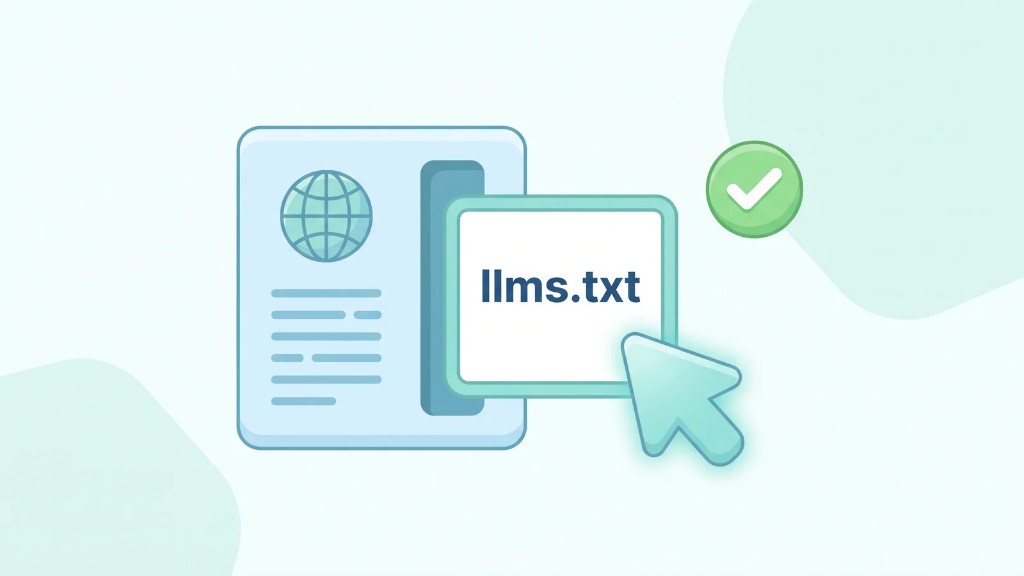
The third check looks for an llms.txt file at the domain root and, if it finds one, verifies that it is properly formatted: correct heading, sufficient content, and links.
This is the check worth paying attention to, because Google has started scoring an AI Discovery File as a measure of agent readiness.
Google Is Now Scoring an AI Discovery File
The idea behind AI Discovery Files is simple: machine-readable inputs published by a site so that AI systems can discover it, interpret it, and trust it. Not rankings. Not brand mentions. Inputs.
Now Google’s own performance tool measures one of them. The llms.txt check inside Agentic Browsing is Google validating an AI Discovery File, in the same report as Performance and SEO.
The SEO community noticed with the same surprise. Marie Haynes (Marie Haynes Consulting) noted how remarkable it is that one of the checks focuses on llms.txt. Remarkable, because the same community had spent much of the spring arguing the file was not worth the effort.
The truth is more nuanced: llms.txt does a narrow, specific job. A diagnostic check inside Lighthouse is exactly that job, officially.
An important clarification: the check rewards a valid llms.txt. It does not prove that major LLMs download it and use it for responses. Those are two different claims. What has changed is the direction: a year ago, publishing an AI Discovery File was a bet on the future of the web. Today, Google’s tools give you a green tick.
Why There Is No Score From 0 to 100
The first thing that confuses users is the format. Every other Lighthouse category gives a number out of 100, with colors and weights. Agentic Browsing gives 3/3 or 2/3 and a list of what passed. This is intentional.
“Because standards for the agentic web are still forming, the current focus is on collecting data and providing actionable signals rather than a definitive ranking.”
Chrome for Developers, official Lighthouse agentic browsing scoring documentation
Google could have invented a “definitive” weighted score and let everyone chase it, the way the industry has done with the Performance score for years. It did not. It said, in other words, that the agentic web has not stabilized enough to give you a grade, so it provides clean signals instead.
There is a second consequence. A simple page with no AI work at all can still pass. Google does not penalize sites for lacking agentic features. A simple, valid page with a clean accessibility tree and stable layout will score well even without an llms.txt. The category is not a stick. It is a readiness signal.
The Fourth Check: WebMCP
There is a fourth audit in the category that does not appear in the 3/3, and it is the most forward-looking of all.
WebMCP is a proposed standard that allows a site to declare specific actions an agent can call directly: form submission, booking initiation, add-to-cart. Instead of the agent guessing how your interface works from a screenshot, you give it labeled controls.
It is a good idea, but it is not ready. The WebMCP audit requires Chrome 150 and origin trial registration to run at all, and it carries low weight while the standard stabilizes. In practice it can fail on nearly every site on the web today, even on sites that do everything else correctly. That is why it stays outside the default pass ratio.
Do not worry about WebMCP yet. Monitor it. llms.txt went from niche proposal to Lighthouse check in about a year. When WebMCP “graduates,” sites that are already thinking in machine-readable structure will adopt it quickly.
How to Pass 3/3
None of the three default checks is exotic. If you are building pages properly, you are already most of the way there.
Clean Up the Accessibility Tree
Give every interactive element a real, programmatic name. Buttons that say what they do. Form fields with associated labels. Links with text, not just an icon. Do not hide interactive content from assistive technology with aria-hidden or off-screen techniques.
Good accessibility and good agent-readability are the same mechanics. A rare case where one fix pays two bills.
Keep the Layout Stable
Reserve space for images and embeds with explicit width and height so nothing reflows when they load. Avoid banners or ads that push content down. Watch out for web fonts: a delayed font swap is a classic CLS shift.
The target is Cumulative Layout Shift near zero. The same target Core Web Vitals already set, now with double value for agents.
Publish a Valid llms.txt
Place an llms.txt at the domain root with a clear H1, a useful description of what the site is and what it offers, and links to the key pages.
itdev.gr already has llms.txt at the root. If you want to see how it is structured, you can use it as a reference.
A detail that trips up many sites: a rule in robots.txt or a CDN setting can silently block the agents you are trying to attract. Verify that AI crawlers are allowed.
What 3/3 Does Not Mean
It would be easy to wave the perfect ratio and imply it brings you AI traffic. It does not, and the honest reading has more value than the headline.
“The agentic browsing category is still marked as ‘under development.‘”
Matt Zeunert, Founder at DebugBear
That sentence does a lot of work. It means the checks can change, the scoring can change, and over-confidence in today’s 3/3 is misplaced.
3/3 means an agent can read your page, the layout will not betray it, and your llms.txt is valid. It does not mean ChatGPT, Gemini, or Google’s AI surfaces will cite you on every prompt. It does not even prove they download your llms.txt.
Agentic Browsing is the floor you build on, not the building.
What Agent-Ready Means in Practice
The three checks are abstract until you see a site built to pass them before Google even gave the category a name.
A fast, stable business page with a clean accessibility build and a valid llms.txt is exactly the kind of page the three checks reward. Specific, well-structured content; area pages with real service details; stable layout with no CLS surprises.
At IT DEV we apply this logic from the start on our projects: technical SEO, GEO for AI search, llms.txt, proper content structure, and Core Web Vitals that pass both the human test and the agent test.
Frequently Asked Questions
What is Agentic Browsing in PageSpeed Insights?
A category Google added to Lighthouse (and by extension to PageSpeed Insights) in May 2026. It measures how ready a page is for AI agents, alongside the familiar Performance, Accessibility, Best Practices, and SEO. Instead of 0–100 it shows a pass ratio, e.g. 3/3.
What does the Agentic Browsing category check?
Three default checks: an agent-centric reading of the accessibility tree, Cumulative Layout Shift, and the presence/validity of llms.txt at the domain root. A fourth check, WebMCP, is experimental and does not count toward the default score.
How do I pass Agentic Browsing with 3/3?
Make sure interactive elements have proper names and roles, keep CLS low, and publish a correctly formatted llms.txt with a heading, content, and links.
Why is there no 0–100 score?
Google chose a pass ratio because the agentic web standards are still forming. The goal is actionable signals, not a definitive ranking. Sites without AI features are not penalized.
Does it affect Google ranking?
No. It is a developer diagnostic, not a ranking factor, and the category is explicitly under development. 3/3 is a readiness signal, not a promise of traffic or AI citations.
Do I need llms.txt to pass?
The llms.txt check only flags an issue if the file exists and is malformed. A site without the file does not fail on that alone. However, a valid llms.txt is the clearest way to turn the check green and signal an AI-readable summary of your site.
What is WebMCP?
A proposed standard that allows a site to declare actions an agent can call (form, booking, etc.). The audit is experimental, requires Chrome 150 and an origin trial, and does not block 3/3.
Want to check if your site is ready for AI agents? Get in touch or see our SEO packages.